
WELCOME BONUS 300%
UP TO €2000 + 100
FREE SPINS
UP TO €2000 + 100
FREE SPINS
Home → Blackjack
Blackjack at OxiBet: Variants, Rules and Payouts
Double Down or Just Hit on 11
Blackjack 6 decks with S17, DAS and DOA rules reaches an RTP of 99.54% and a house edge of 0.46%, a figure that assumes basic strategy is followed on every decision. Doubling down on a first two-card total of 11 commits a second unit to the hand and draws exactly one more card, which is why the rule set that permits doubling on any first two cards produces that 0.46% edge rather than a higher one.
Compare that with the 6:5 payout version on 6 decks, where the RTP falls to 98.15% and the house edge rises to 1.85%. The gap between the two is 1.39 percentage points of house edge, and that entire spread comes from the blackjack payout alone, not from the doubling decision, so a player who doubles correctly on 11 still faces the weaker return at such a table.
On a €10 bet, a blackjack paid at 3:2 returns €15 while the same hand at 6:5 returns only €12, a difference of €3 per qualifying hand. Over 100 such hands the shortfall adds up to €300, which is why checking the payout line before sitting down matters more than any single playing decision on 11.
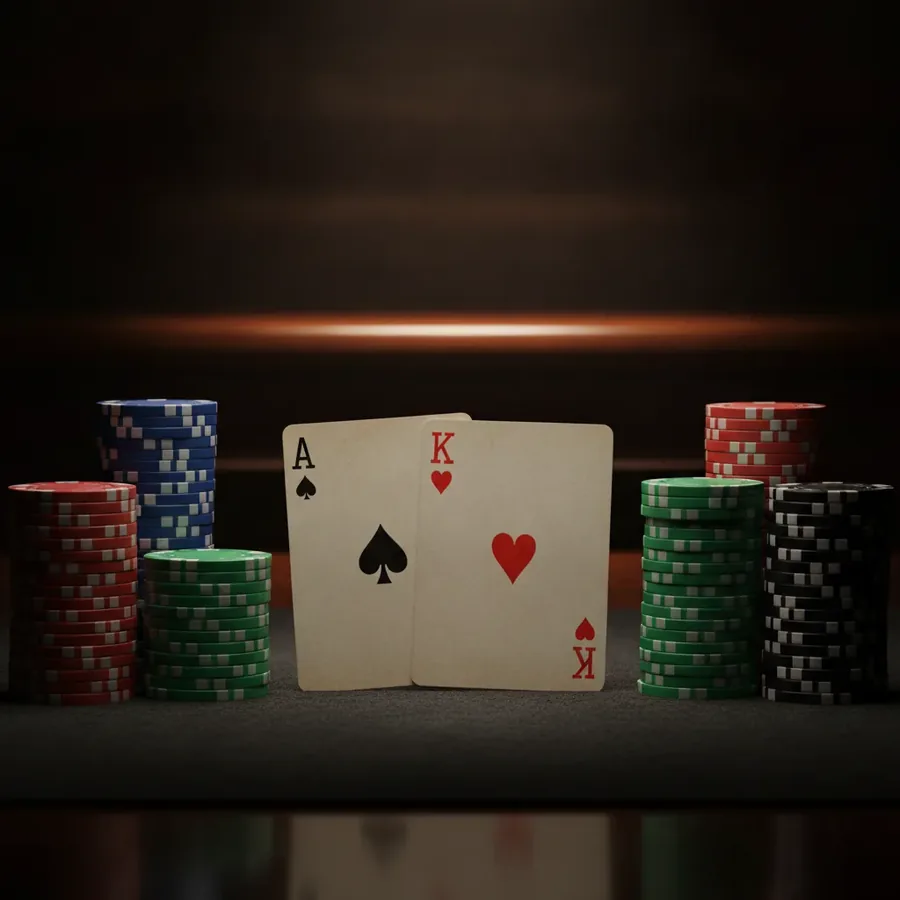
Bet Two Percent of Your Bankroll per Hand
A €100 bankroll split into 2% units gives a stake of €2 per hand, and at the 0.46% house edge of the 6-deck S17, DAS, DOA game the expected cost is roughly €0.01 per hand. That is the average share of each stake the casino keeps, applied across hundreds of thousands of rounds rather than any single session.
At the higher edge of the 6:5 game, 1.85%, the same €2 stake carries an expected cost near €0.04 per hand, so the 2% sizing rule absorbs the weaker rule set but drains the bankroll faster. Insurance, priced at a 7.47% house edge on 6 to 8 decks, is a separate side bet of up to 50% of the main bet and basic strategy always declines it outside card counting at a true count of at least +3.
Infinite Blackjack from Evolution accepts bets from €1 to €5,000 and returns 99.47%, while Lightning Blackjack from the same studio runs from €1 to €2,500 at 99.56%. A €2 unit sits at the bottom of both ranges, which keeps the 2% rule workable even when the table minimum is €1.
Doubling After a Split: Which Tables Allow It
Doubling after a split, or DAS, lowers the house edge by about 0.14 percentage points, and it appears in the rule set behind the 99.54% RTP of the 6-deck S17 game. Blackjack Liberal Vegas Strip also carries DAS and reaches 99.72% RTP with a 0.28% house edge, making it the stronger of the two configurations.
Without DAS a player who splits a pair of eights and then draws a favourable total cannot add a second unit, and that lost option is worth roughly 0.14 percentage points of return. Splitting allows up to 4 hands in the standard rule set, and split aces usually receive one card each, which limits how often the doubling option becomes relevant.
Blackjack Party from Evolution carries two hosts and a bet range of €1.00 to €1,000, while Infinite Blackjack from the same studio spreads €1 to €5,000 across unlimited seats. A player sizing at 2% of a €100 bankroll stakes €2 per hand, which fits inside both ranges, though the split-and-double sequence can push a single round to €4 or more.
Calling Late Surrender Correctly in Three Steps
Late surrender lets the player give up the hand after the dealer has checked for blackjack and lose half the stake, improving the return by about 0.08 percentage points. Early surrender is worth up to 0.6 percentage points but is extremely rare, so the late version is the one most tables offer.
Blackjack Liberal Vegas Strip includes late surrender inside its rule set and posts 99.72% RTP against a 0.28% house edge, the most player-friendly combination among the listed variants. The 6-deck S17, DAS, DOA game at 99.54% RTP does not include surrender, so the 0.08 point improvement is unavailable there.
On a €10 stake, surrendering returns €5 and caps the loss at half the bet rather than the full €10. Applied correctly the option saves about €0.008 per €10 staked on average, and that figure only holds when the surrender decision is made after the dealer has checked for blackjack.
Blackjack variants at a glance
| Variant | Payout | House edge | Rule | RTP |
|---|---|---|---|---|
| Blackjack Single deck, classic rules, 3:2 | Blackjack 3:2, win 1:1 | 0.15% | Fewer decks = lower edge; one deck gives about −0.48 percentage points compared with 8 decks. Often offset by a 6:5 payout. | 99.85% |
| Blackjack 6:5 payout instead of 3:2 (6 decks) | Blackjack 6:5, win 1:1 | 1.85% | Replacing 3:2 with 6:5 adds exactly +1.39 percentage points to the casino's edge – more than any other rule change. On a €10 bet a blackjack pays €12 instead of €15. | 98.15% |
| Blackjack Liberal Vegas Strip (liberal rules, 3:2) | Blackjack 3:2, win 1:1 | 0.28% | The most player-friendly rule set: S17 + DAS + resplit + late surrender. Standard deviation 1.15 | 99.72% |
| Blackjack Split / double / H17 – rule effects | Double – stake ×2 with one card; split – up to 4 hands; split aces usually get one card each. | H17 +0.22 percentage points; RSA −0.08 percentage points; DAS −0.14 percentage points | Dealer hitting soft 17 lowers RTP by 0.22 percentage points; resplitting aces improves it by 0.08 percentage points; doubling after a split improves it by about 0.14 percentage points; 6 decks instead of 8 – about 0.02 percentage points. | n/a (rule modifiers) |
| Blackjack 6 decks, S17, DAS, DOA, 3:2 payout, basic strategy | Blackjack 3:2, regular win 1:1, insurance 2:1 | 0.46% | Dealer stands on soft 17; double down on any first two cards; doubling after a split allowed; no surrender. Basic strategy is required to reach this figure | 99.54% |
| Blackjack Insurance (6–8 decks) | Insurance 2:1 | 7.47% | Separate side bet of up to 50% of the main bet when the dealer shows an ace. Basic strategy ALWAYS declines it (except for card counters at a true count ≥ +3). With a single deck the edge is ≈ 5.88% | 92.53% |
RNG Deals From a Virtual Eight-Deck Shoe
A random number generator supplies every card in OxiBet's blackjack games, and the software builds its hands from a virtual eight-deck shoe rather than a physical one. Eight decks sit behind the 6-deck benchmark used by Blackjack 6 decks, S17, DAS, DOA with a 99.54% RTP. Adding two decks to that base costs roughly 0.02 percentage points of return, according to the Blackjack Split, double, H17 rule-effects row.
The eight-deck virtual shoe is a fixed parameter, so the deck count never changes between rounds. One deck instead of eight lifts return by about 0.48 percentage points, which is the gap between the single-deck classic game at 99.85% RTP and the eight-deck baseline. That same single-deck game often pays 6:5 on a blackjack, which cuts return by 1.39 percentage points.
For a player staking €100 per round, the eight-deck virtual shoe keeps about €0.46 on average when the 6-deck rule set is applied at 99.54% RTP, and the same €100 costs €0.28 under the Blackjack Liberal Vegas Strip rules at 99.72% RTP. The shoe itself is invisible; only the rule set around it moves the numbers.
Infinite Blackjack vs the Classic Seven-Seat Table
Infinite Blackjack from Evolution runs with unlimited seats and a bet range of €1 to €5,000, while a classic seven-seat table caps the number of players. The Evolution title returns 99.47% RTP and adds four side bets: Any Pair, 21+3, Hot 3 and Bust It. Its unlimited seat count removes the waiting list that a fixed-seat table imposes.
That 99.56% is 0.09 percentage points above Infinite Blackjack and 0.02 percentage points above the 6-deck 99.54% benchmark. The multiplier applies only to a winning hand, so the base return stays fixed.
Blackjack Party from Evolution sets its bet range at €1.00 to €1,000 and is hosted by two presenters. On a €100 stake, the 99.47% Infinite Blackjack return costs about €0.53 per round, against €0.44 for Lightning Blackjack at 99.56%. A classic seven-seat table with the Liberal Vegas Strip rules returns 99.72%, which is €0.28 per €100.
Which Rule Variants the Software Shows
OxiBet's blackjack floor lists the Blackjack Liberal Vegas Strip rule set at 99.72% RTP with a 0.28% house edge, built on S17, DAS, resplit and late surrender, with a standard deviation of 1.15. The 6-deck S17, DAS, DOA version returns 99.54% and carries a 0.46% house edge, but needs basic strategy to reach that figure. The gap between the two is 0.18 percentage points.
Late surrender as a rule modifier improves return by about 0.08 percentage points, and the player loses half the stake after the dealer checks for blackjack. Early surrender is worth up to 0.6 percentage points more but is extremely rare. Resplitting aces adds 0.08 percentage points, and doubling after a split adds about 0.14 percentage points.
A dealer who hits soft 17 costs the player 0.22 percentage points, and moving from eight decks to six decks adds about 0.02 percentage points. Insurance pays 2:1 but drags the long-run return down to 92.53% with six to eight decks. On a €100 stake, the 99.72% Liberal Vegas Strip set keeps €0.28 per round on average.
Soft 17: Does the Dealer Hit or Stand?
Dealer hitting soft 17 lowers RTP by 0.22 percentage points, and that single rule change sits inside the house edge like a surcharge. The house edge is the average share of each stake that the casino keeps, so the modifier applies to every hand played under that rule, not to a single session. On 100 € of stakes, 0.22 percentage points is 0.22 € handed over hand after hand. Standing on soft 17 is the friendlier setting and appears in the six-deck basic strategy figure of 99.54%.
Blackjack Liberal Vegas Strip reaches 99.72% RTP with S17 combined with doubling after a split, resplitting and late surrender, a house edge of 0.28%. That is 0.18 percentage points better than the 0.46% edge of a six-deck S17 game with doubling after a split and no surrender. Put plainly, 100 € of stakes costs 0.28 € on the liberal rule set against 0.46 € on the narrower one. The gap comes from the surrender option the liberal set keeps.
Resplitting aces improves RTP by 0.08 percentage points and doubling after a split by about 0.14 percentage points, so H17 is not the only lever. Comparing the two, doubling after a split recovers roughly twice what resplitting aces adds. A player facing a hit-soft-17 table with doubling after a split allowed is closer to the S17 benchmark than one facing resplit aces alone. The H17 penalty of 0.22 percentage points still outweighs either benefit on its own.
Six to Eight Decks in the Shoe
Six decks instead of eight is worth about 0.02 percentage points of RTP, a small step next to the other rule modifiers. Blackjack Single deck, classic rules, 3:2 shows the direction clearly: one deck gives about 0.48 percentage points compared with eight decks, reaching 99.85% RTP and a 0.15% house edge. The single-deck figure assumes classic rules and a 3:2 payout on blackjack. Fewer decks means fewer cards between shuffles and a thinner casino margin.
The six-deck benchmark with S17, doubling after a split, double on any first two cards and a 3:2 payout sits at 99.54% RTP and a 0.46% house edge. On 100 € of stakes that is 0.46 € kept on average, against 0.15 € on the single-deck classic game. The 0.31 percentage point difference is larger than the 0.02 percentage point step from eight decks to six. Deck count alone does not explain the spread; the accompanying rules do much of the work.
Blackjack 6:5 payout instead of 3:2, with six decks, lands at 98.15% RTP and a 1.85% house edge. Swapping 3:2 for 6:5 adds exactly 1.39 percentage points to the casino's edge, more than any other rule change. On a €10 bet a blackjack pays €12 instead of €15, a €3 difference on a single winning hand. A 6:5 table wipes out the small gain from trimming the shoe from eight decks to six many times over.
Split, Double Down and Surrender by the Numbers
Doubling after a split improves RTP by about 0.14 percentage points, while late surrender improves it by about 0.08 percentage points. Late surrender means the player gives up the hand after the dealer has checked for blackjack and loses half the stake, so 50% of the stake is returned. On a €10 hand that is €5 back instead of a full loss. Early surrender is worth up to 0.6 percentage points but is extremely rare.
Splitting runs up to 4 hands, and split aces usually receive one card each. Doubling doubles the stake with one card to come. A player who splits to four hands at €10 each has €40 committed before any double, and a double on one of those hands raises it to €50. The 0.14 percentage point gain from doubling after a split applies across all that extra money.
Insurance is a separate side bet of up to 50% of the main bet when the dealer shows an ace, paying 2:1. Insurance on six to eight decks returns 92.53% RTP with a 7.47% house edge, and basic strategy always declines it except for card counters at a true count of at least +3. With a single deck the edge is about 5.88%. A €10 insurance bet at a 7.47% edge costs about €0.75 per bet on average, against €0.46 on a six-deck S17 main game.
The Shoe, the Cut Card and 75% Penetration
Penetration of 75% means the cut card sits three-quarters of the way through the shoe, so roughly a quarter of the cards stay behind the cut and are never dealt. In a six-deck shoe that leaves about 1.5 decks undealt. The deeper the cut, the fewer shuffles interrupt play and the more hands come from the same shuffled stack. The rule modifiers already covered move RTP by 0.02 to 0.22 percentage points; penetration changes how often those modifiers repeat across a session.
Blackjack 6 decks, S17, DAS, DOA, 3:2 payout, basic strategy returns 99.54% RTP with a 0.46% house edge, and that figure assumes basic strategy is played. At 75% penetration, roughly three of every four cards in the shoe reach the table. Over 100 € of stakes the 0.46% edge is 0.46 € on average, and the cut card does not change that number; it changes how many hands share the same shuffle.
Blackjack Single deck, classic rules, 3:2 reaches 99.85% RTP and a 0.15% house edge, and a single deck turns over far more often than a six-deck shoe at 75% penetration. The 0.48 percentage point gap between one deck and eight decks is the deck-count effect, separate from where the cut card lands. Shuffling more often resets the composition of the remaining cards, which is what the penetration figure describes. The two effects are counted separately in the RTP figures.
Clicked Too Late? The Hand Stands Automatically
A hand that is automatically held when the decision clock runs out is resolved as it stands, with no further split, double or surrender. That matters most for late surrender, which returns 50% of the stake and improves RTP by about 0.08 percentage points. A player who intended to surrender but clicked too late keeps the full stake at risk instead of getting half back. On a €10 hand the missed surrender is a €5 swing.
Blackjack 6:5 payout instead of 3:2, with six decks, returns 98.15% RTP and a 1.85% house edge, and a held hand on a 6:5 table collects €12 on a €10 bet instead of €15. The 1.39 percentage point edge added by the 6:5 payout applies whether the hand is played out or held. A held hand is simply a hand played with the default action. Insurance also lapses: it is a side bet of up to 50% of the main bet that basic strategy always declines.
Blackjack Party from Evolution runs a bet range of 1.00 EUR to 1,000 EUR. A held hand on any of these tables still settles at the table's own RTP, so the 0.09 percentage point gap between 99.47% and 99.56% is unaffected by the clock.
Contact
Live - online chat
Banking









Providers












OxiBet 2026